They Never Saw My Wheelchair Before They Saw Me
By Rotarian Sanj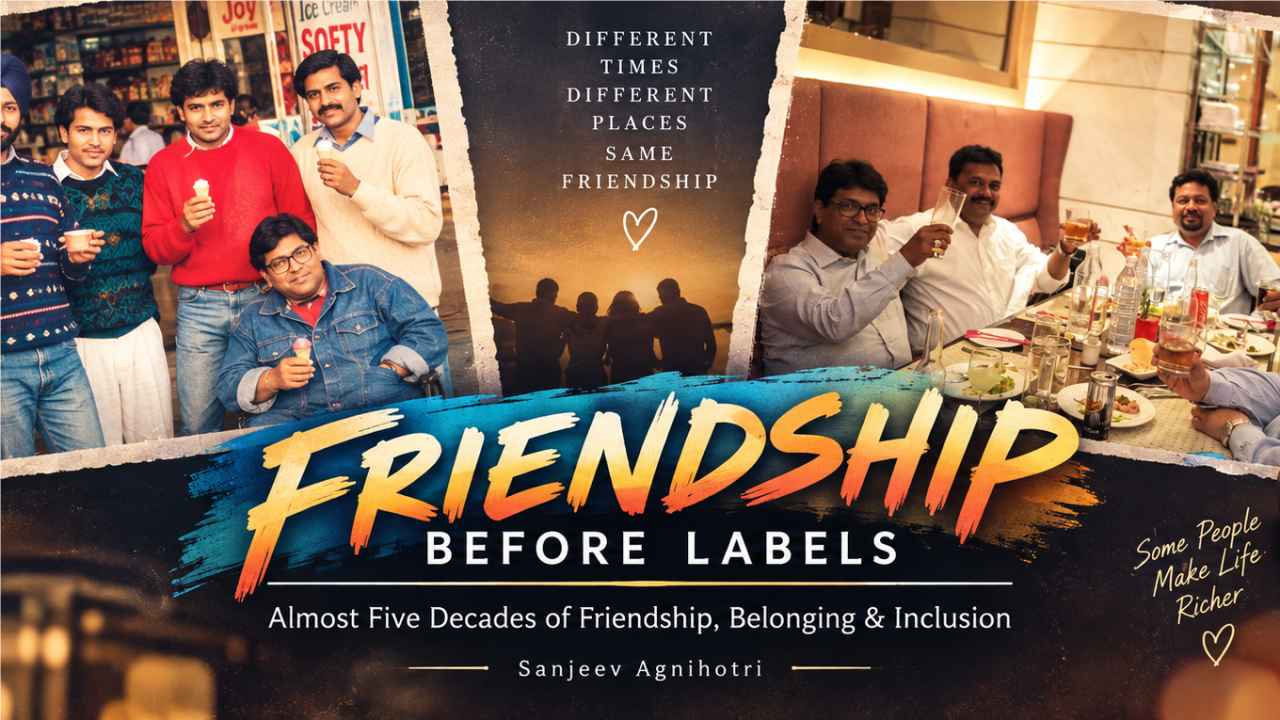 eev Agnihotri
What almost five decades of childhood and college friendships taught me about friendship, belonging, inclusion and the values that shaped my life.
I know LinkedIn is not usually the place where we share the most personal parts of our lives. Most of us come here to talk about our work, professional achievements, leadership, ideas and causes we care about. Today, I want to make an exception. I want to talk about friendship.
The two photographs I am sharing with this article represent almost four to five decades of my life. One takes me back to friendships that began in childhood. The other represents friends from my college days. Looking at these photographs brought back countless memories, but it also made me realize something much deeper. These people helped shape the person I am today.
Friends Before Disability
I contracted polio when I was only 18 months old. Disability, therefore, has been part of virtually my entire life. I grew up using a wheelchair. There was never really a “before disability” version of Sanjeev that my childhood friends knew.
And yet, when I think about those friendships, disability is strangely not what comes to mind. I remember laughter. I remember arguments. I remember adventures, teasing, stupid jokes, disagreements, celebrations and, of course, merciless leg-pulling that continues even today.
They never became my friends because I was disabled. They became my friends because I was Sanjeev. They never made me feel that I was less than any one of them. They did not constantly remind me of what I could or could not do.
At the same time, whenever my disability meant that I genuinely needed physical assistance, someone was simply there. There was no announcement. No pity. No expectation of gratitude. No feeling that somebody had performed an extraordinary act of kindness for their “disabled friend.” They just helped me and we carried on.
Looking back today, I realize how extraordinary that ordinary behaviour actually was.
When Brothers Become Friends, and Friends Become Brothers
There is another reason the first photograph is particularly special to me. My younger brother and my cousin are also in it. But calling them simply my brother and cousin does not quite describe our relationship. They have always been among my friends. And somewhere along the journey, many of my friends stopped feeling like friends and became brothers.
My youngest brother and a few other very dear lifelong buddies are missing from these two photographs. Their absence from the pictures certainly does not mean they are absent from the story. They are part of the same journey.
Through different stages of my life, I have been fortunate to have people around me who understood something very simple:
Help me when I need help. Fight with me when you disagree with me. Laugh with me. Laugh at me. Pull my leg. But never reduce me to my disability.
That, to me, is friendship. And perhaps it is also one of the purest forms of inclusion.
Before I Knew the Word “Inclusion”
Today, disability advocacy is an important part of my life. I speak about accessibility, dignity, equality, inclusion and lived experience. But when I was young, we weren't sitting around discussing the terminology of disability inclusion. My friends were simply practising it. They included me because I belonged.
There is an important difference between helping someone and making that person feel helpless. My friends somehow understood that difference without needing a workshop or an accessibility manual. They recognized when I needed assistance because of my disability, but they never confused needing assistance with being less capable, less valuable or less equal.
That lesson has stayed with me.
Real inclusion isn't constantly reminding someone that they are different and then congratulating ourselves for accepting them. Sometimes inclusion is much simpler. It is allowing someone to belong completely while recognizing and supporting their individual needs when necessary.
Where My Values Really Came From
People sometimes assume that because someone has lived with a significant disability, their compassion, resilience, determination or values must somehow have come from their disability.
I see my own life differently.
My values did not come from polio. They came from my parents. They came from my brothers and family. They came from my wife. They came from friendships lasting four and five decades. They came from education, work, mistakes, responsibilities, successes, disappointments, love, arguments, laughter and simply living life.
They came from people who stood beside me and from experiences that challenged my thinking.
Disability influenced my experiences, of course. It exposed me to barriers and inequalities that many people never have to think about. Those experiences eventually became an important part of my advocacy. But I don't want disability to receive credit for everything good in my life.
I Live Fully With Disability. I Don't Celebrate Having It.
This distinction matters deeply to me.
I have lived my life fully with my disability. But living fully with disability does not mean I have to celebrate having a disability. I can be proud of who I am without being grateful that I contracted polio. I can celebrate my life without celebrating the condition that took away my ability to walk.
I can acknowledge that disability has shaped some of my experiences without saying that I needed disability in order to develop values, compassion or strength. And I can advocate fiercely for disability rights, accessibility, dignity and inclusion without romanticizing disability or suffering.
These ideas can coexist.
For me, disability is part of my life. It is not the explanation for my entire life.
Almost Five Decades Later…
Time has done what time does. We grew older. Careers happened. Families happened. Responsibilities multiplied. Some of us moved thousands of kilometres away. There is a little less hair in some places and considerably more grey in others.
But something funny happens when old friends get together. For a few hours, the decades disappear. Suddenly we are those boys again. Same friendship. Same bonding. Same love. Same energy. Same madness. And absolutely the same leg-pulling. Maybe even worse.
That is why I wanted to share these photographs here. Not simply because they make me nostalgic for the 80s and 90s, but because behind these pictures is a lesson that has stayed with me for almost my entire life.
These friends never needed to ignore my disability. They simply never allowed it to become more important than ME.
And when I think about the work I do today in disability advocacy, perhaps the foundation was being laid decades before I even knew what advocacy meant.
Before policies. Before accessibility standards. Before DEI. Before I ever used phrases such as lived experience or disability inclusion.
I already knew what genuine belonging felt like. Because I had lived it.
Before I ever learned the language of disability advocacy, these people had already taught me what inclusion feels like.