The Crossword Puzzle of Polio and Post-Polio Syndrome
By Professor Michael Kossove
Post-Polio Syndrome, or PPS, can sometimes feel like a crossword puzzle that nobody gave us the answers to. We know many of the clues. We recognize some of the symptoms. We can see the patterns. But putting all the pieces together has taken decades—and, for many polio survivors, the puzzle is still being solved.
For those of us who lived through polio, the first part of the story began long before anyone had heard the words Post-Polio Syndrome.
During the great polio epidemics of the 1940s and 1950s, the immediate concern was survival. Poliovirus could attack the nervous system and damage motor neurons, leaving some children and adults with paralysis, weakened muscles, breathing problems, and permanent disabilities. The medical community concentrated on getting patients through the acute illness and helping them recover as much function as possible
And then, for many survivors, life moved on.
We went to school. We went to college. We got married. We had children. We found jobs and careers. We participated in sports, traveled, raised families, and became productive members of our communities.
Many of us assumed that polio was something that had happened to us in the past.
Then, decades later, something changed.
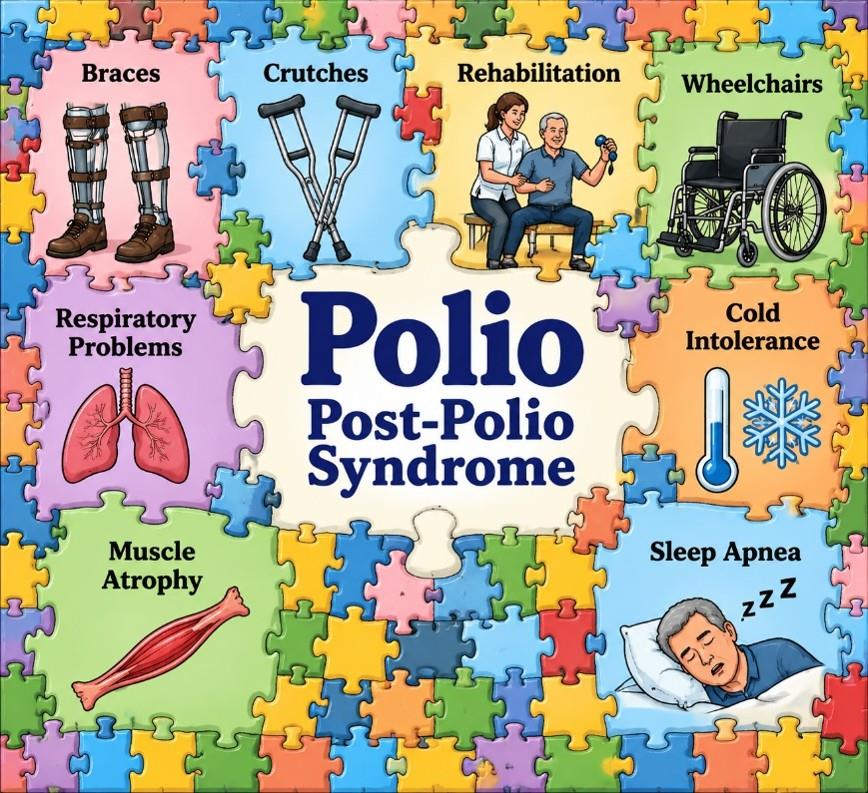
A leg that had always been weak became weaker. Walking became more difficult. Stairs that had once been manageable became a challenge. Muscles became tired more easily. Some survivors developed pain, fatigue, sleep problems, breathing difficulties, or an unusual sensitivity to cold. Others noticed that activities they had performed for years suddenly required enormous effort.
The crossword puzzle had acquired new clues.
At first, many survivors—and sometimes their physicians—wondered whether these problems were simply part of getting older. After all, if someone was in their 60s, 70s, or 80s, wasn't fatigue or weakness just aging?
But something didn't seem right.
The weakness often occurred in muscles that had already been affected by polio. Sometimes previously unaffected muscles became involved as well. Survivors who had compensated for decades by asking more of their remaining motor neurons appeared to be reaching a physiological limit.
Researchers began studying these late effects more systematically. During the 1970s and 1980s, awareness of what became known as Post-Polio Syndrome increased dramatically. Polio survivors began coming together, sharing experiences, and saying something very important:
“This isn't just aging. Something is happening to us.”
That statement helped change the conversation.
Research suggested that when poliovirus destroyed motor neurons during the original infection, the surviving neurons sometimes compensated by sending out additional branches to take over muscle fibers that had lost their original nerve supply. This remarkable process, called collateral sprouting, allowed many survivors to regain function and remain active for decades.
But the solution came with a price.
The surviving motor neurons were doing the work of many.
For years—and sometimes for half a century—they continued carrying an unusually large workload. Eventually, some of these enlarged motor units may become unable to maintain that workload. The result can be new weakness, fatigue, muscle and joint pain, and declining endurance.
But the puzzle is incomplete..
There is no single laboratory test that says, “Yes, you have Post-Polio Syndrome.” Diagnosis generally depends on a person's history, previous poliovirus infection, new symptoms, clinical examination, and ruling out other possible causes.
That makes PPS particularly frustrating.
A survivor may be told that the fatigue is normal aging. The weakness may be attributed to arthritis. Pain may be blamed on a bad knee or shoulder. Sleep problems may be treated separately. Breathing difficulties may be attributed to another condition.
Sometimes the individual pieces are treated, but nobody looks at the entire crossword puzzle.
Today, our understanding of PPS is much better than it was several decades ago. We recognize that it can involve more than muscle weakness. Fatigue, pain, reduced endurance, sleep disturbances, swallowing or breathing difficulties, and problems related to long-term physical compensation may all affect a survivor's quality of life.
We have also learned an important lesson: doing more is not always better.
Many polio survivors grew up believing that if something was difficult, they simply had to work harder. That attitude helped us survive and succeed. But with PPS, constantly pushing weakened muscles beyond their capacity may make matters worse.
Energy conservation, pacing, appropriate exercise, assistive devices, good sleep, weight management, and attention to respiratory and other health issues can become important parts of living successfully with PPS.
And perhaps the most important development has been recognizing the value of other survivors.
Support groups, conferences, newsletters, Zoom meetings, and online communities have given survivors something that medicine alone cannot provide: the reassurance that we are not imagining this, and we are not alone.
The crossword puzzle isn't finished.
Researchers continue investigating why some survivors develop significant post-polio problems while others experience relatively few difficulties. We still have questions about the mechanisms behind progressive weakness, fatigue, pain, sleep problems, and other symptoms.
But after decades of searching for answers, we have filled in many of the squares.
We know where the puzzle began.
We understand much more about what happened to the motor neurons.
We recognize that the effects of polio did not necessarily end when the acute illness ended.
And we know that growing older with a history of polio is not quite the same as growing older without that history.
If There Were an Encyclopedia Polio
Growing up, many of us remember the Encyclopedia Britannica. It was a remarkable collection of knowledge, but it was never really finished. Each year, updated editions appeared, adding new information, correcting what we previously thought we knew, and expanding our understanding of the world.
Sometimes I think about what would happen if there were an Encyclopedia Polio.
There would have to be a new edition every year.
And especially now, in the era of Post-Polio Syndrome, the encyclopedia would continue to grow beyond today. Researchers would add new discoveries. Physicians would add new observations. And survivors themselves would contribute new experiences.
Because there was never just one kind of polio experience.
Each of us was affected differently.
Some had paralysis. Some did not. Some required braces, crutches, or wheelchairs. Others walked independently for decades. Some experienced respiratory problems, while others did not. Some recovered remarkably well and remained active for most of their lives.
And now PPS has added another chapter.
As we grow older, we may witness changes in our bodies that we never expected. A muscle becomes weaker. Walking takes more energy. Fatigue arrives sooner. Pain appears where it wasn't before. Balance may change. Sleep or breathing may become more difficult. Activities that once seemed routine may require planning.
And those changes don't necessarily happen all at once.
Each year can bring another clue.
Just when we think we understand our bodies, something new may appear. We have to reassess, adapt, and sometimes learn an entirely new way of doing something we have done for decades.
So perhaps an Encyclopedia Polio would never have a final edition.
The story would continue to be revised and expanded—not because we have failed to find the answers, but because there are still new questions to be asked.
And that brings us back to our crossword puzzle.
The original puzzle had many pieces.
PPS added new pieces.